
Stress Awareness Month: Where does stress come from and what causes stress?
In the first installment of a four-part blog series exploring every facet of stress, we examine what causes stress in our lives and how too much stress can negatively impact our health -- as well as how too little stress isn't necessarily a good thing.
Needing stress to perform
Stress is a normal part of the human experience and is needed to motivate us in achieving our goals. Your job, studies, relationships, and even securing food can all contribute to stress – it’s a constant presence in nearly every part of life.
Although having a ‘stress-free’ life might seem like the ideal, removing stress altogether can actually have negative impact on our minds and bodies. In a recent NPR article, Dr. Jeremy Jamieson, a psychologist at the University of Rochester, talks about the positive effects the right level of stress can have on our cognitive function. “By informing people of the benefits of stress responses in [certain] settings, they latched on to the idea, I can lean into my stress,” Dr. Jamieson said, and use it to help do important things.
Positive or negative stress?
The term stress is often equated with distress; An image might spring to mind of someone losing sleep over unpaid bills, juggling multiple deadlines at work, or arguing with a friend.
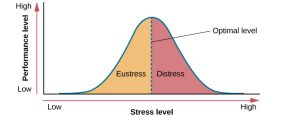
However, not all forms of stress are bad for us. If distress is the kind of stress that negatively impacts our wellbeing, then eustress is the motivator that helps us to perform at our best and deal with any oncoming challenges.
The Yerkes-Dodson law, as shown in the graph above, demonstrates how different levels of stress can affect us. As the level of stress increases, pushing you from ‘inactive’ toward ‘eustress’, your body enables you to start thinking more productively and puts you in problem solving mode.
However, as stress builds to an unmanageable level or becomes chronic stress, where your body is at a level of distress for a prolonged period without relaxation, your body will begin to tire of constantly injecting you with energy to accomplish your tasks. This is when we start to feel fatigued, burned out, dissatisfied, or overwhelmed.
It is important to have coping skills and forms of relaxation that enable us to move between calm and ‘eustress’ when approaching different stressors in our lives. If the occasional Netflix binge is an effective way to wind down after a stressful day, it’s worth doing!
Stress is not always considered a negative, as it can motivate us and help us rise to the challenges we see in everyday life. However, making sure we understand what causes us to feel negative stress will help our wellbeing long-term.
Throughout stress awareness month, we’ll be sharing weekly content that takes an in-depth look at different topics on stress. In the next blog, which will be out next week, we’ll be discussing the body’s physical reaction to stress and how it can continue to live in our bodies.
Get in touch
Whether you’re looking for a way to reduce stress levels amongst the people in your care or would simply like to give them a place to self-manage their mental wellbeing, Togetherall’s scalable solution is available 24/7. If you’d like to find out more, select the button below to contact and schedule a time to talk with one of our team.