How the University of Illinois Chicago views expanding access as a priority
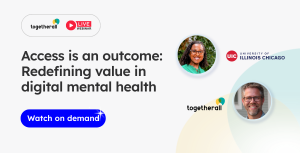
In our recent webinar, Togetherall’s Dr. Ben Locke and Dr. Shenay Bridges-Carter of the University of Illinois Chicago (UIC) discussed the considerations of treating access as an outcome when evaluating ROI in mental health services, with insight into UIC’s approach in supporting students.
What does it mean for a college or university to measure the impact of its mental health services? Traditionally, the answer has focused on clinical outcomes: How many students were treated? How satisfied were they? Did their symptoms improve?
In our recent discussion, Access Is an Outcome: Redefining Value in Digital Mental Health, Dr. Ben Locke, Chief Clinical Officer at Togetherall, and Dr. Shenay Bridges-Carter, Executive Director of the Counseling Center at the University of Illinois Chicago (UIC), explored a broader question:
What happens when access itself is treated as an outcome?
For Dr. Locke, expanding access is fundamental to expanding impact. Traditional counseling centers play a critical role, but they cannot reach every student who could benefit from mental health support. As he explained,
“The people we don’t reach in traditional services, when we are able to reach them, connect with them, provide them with access, that in and of itself is a meaningful outcome.”
Access means removing barriers
Barriers to mental health support are not limited to clinical capacity. Students may face stigma, scheduling challenges, waitlists, limited availability, or simply may not see a counseling center as the right place to turn.
Dr. Bridges-Carter described arriving at UIC and encountering a widespread perception that the counseling center had a months-long waiting list and strict session limits. While perceptions did not always reflect reality, she found that they could still become barriers to accessing care.
Her response included removing session limits and giving clinicians greater flexibility to use their clinical judgement. She also focused on creating additional pathways into support through partnerships with services such as Togetherall.
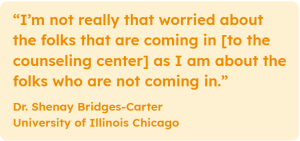
Importantly, Dr. Bridges-Carter emphasized that the goal is not to make every student enter through the same door.
Digital support creates more doors
Digital mental health services can help universities create additional pathways to support, particularly for students who may not access traditional services.
Dr. Locke highlighted the value of being able to access peer support at the point when a student needs it:
“If I’m in a moment of need at 2 in the morning, and I get on Togetherall and find somebody with a similar experience, I’ve gained access to support with no barriers.”
For Dr. Bridges-Carter, peer support reaches a student need that a counseling center may never be able to address. She shared,
“I really recognize the importance and the value of peer support and how it reaches a certain student need that the counseling center likely would never be able to meet. I know there’s unique value in the support that students receive from one another and appreciate that it’s something that clinicians cannot provide to folks that they are meeting with one-on-one.”
Rethinking how universities measure value
The conversation also challenged institutions to broaden how they evaluate mental health investments. Satisfaction and clinical outcomes remain important, but they are only part of the picture.
Dr. Bridges-Carter described success as expanding the number of students who can access support, including through classrooms, learning management systems, and partnerships. At UIC, partnerships with digital and virtual services helped extend the reach of the counseling center beyond what it could provide alone.
This points to a more comprehensive framework for evaluating mental health investments: Who can access support? How quickly? Through how many pathways? Who is still being missed? And can the model scale as student needs change?
Building a stronger campus wellbeing ecosystem
Ultimately, the conversation reinforced that access, equity, outcomes, and scalability are interconnected. Expanding access does not mean replacing counseling centers or other established services. Instead, it means creating a network of complementary pathways that allow students to find the right level and type of support for their needs.
As Dr. Locke noted, we need to be thinking about population-wide solutions that provide basic access for everybody.
For universities looking to strengthen their mental health ecosystems, the takeaway is clear: access is more than a measure of reach. It is an essential part of the value and impact of a mental health support system.
About Togetherall
To date, Togetherall is available to 4.5 million students worldwide at more than 350 colleges and universities. Togetherall is the leading clinically managed, peer-to-peer, online support community where students can share what’s on their minds, anonymously, safely, and in-the-moment, 24/7/365. Students can connect through shared lived experiences with a global network of peers, backed by the safeguarding of real, live, mental health practitioners overseeing the community around-the-clock. These practitioners empower individuals in peer support and foster and maintain a safe, vibrant environment.
Togetherall is the only peer-to-peer support platform regulated by the MHRA under the Software as a Medical Device (SaMD) framework, reflecting the strong clinical governance, 24/7 moderation, and transparent risk oversight the platform has always upheld.
If you are interested in offering safe and scalable ways to support your students’ mental health, contact us to find out more about Togetherall’s online community.