Blog & Webinar: What does it actually take to support mental health at scale? Here’s what three organizations told us
Mental health demand is rising. Everyone knows it. The harder question - the one organizations are quietly wrestling with every day - is what to actually do about it when you're responsible for the wellbeing of thousands, or hundreds of thousands, of people at once.

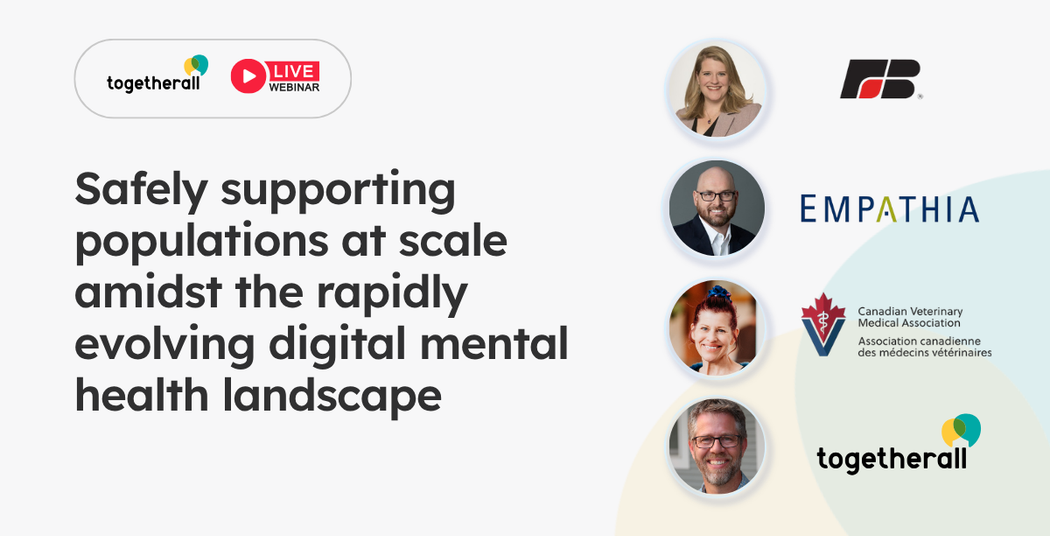
That was the conversation at the heart of our recent webinar, ‘Safely Supporting Populations at Scale Amidst the Rapidly Evolving Digital Mental Health Landscape’. Togetherall’s Chief Clinical Officer, Dr. Ben Locke, was joined by three leaders who are doing this work in practice: Jessica Cabrera, Managing Director of Member Engagement at the American Farm Bureau Federation (AFBF); Brian Summers, Chief Growth Officer at Empathia; and Dr. Kathy Keil, Director of Wellbeing, DEI, and Accessibility Programming at the Canadian Veterinary Medical Association (CVMA).
What followed was an honest, practical conversation about the realities of scaling mental health support – the structural challenges, the decisions that don’t have obvious answers, and what’s actually working.
The gap between demand and capacity isn’t going away
Ben opened with a framing that set the tone for everything that followed. Over his career in mental health – from wilderness therapy to hospital settings to higher education – one thing became consistently clear: the capacity of one-to-one treatment simply cannot keep pace with the demand we’re now seeing.
This isn’t a failure of the system. It’s a structural reality. Reduced stigma, increased awareness, and broader conversations about mental health have all done their job – more people are willing to ask for help than ever before. But the treatment infrastructure hasn’t scaled with that shift. And the result is a growing group of people who need something, even if it’s not clinical treatment, and who currently have nowhere to go.
“There just aren’t enough providers,” Ben said. “And there’s all kinds of folks who’ve said, well, you told me I should come forward and ask for help. So how do we do that at scale without swamping treatment systems – and how do we continue to do it safely?”
That question became the thread running through everything the three panelists shared.
Three very different organizations. Very similar challenges.
What struck us most listening back to this conversation was how different the three organizations are – in sector, geography, membership type, and infrastructure – and yet how many of the same challenges they’renavigating.
The American Farm Bureau Federation represents 5.5 million member households across the United States. Membership happens at the county level, through 2,800 county farm bureaus that feed upward through state bureaus to the national organization. It’s a deeply grassroots structure – and as Jessica described it, that’s precisely where its power lies. Members and community advocates are actively engaged at every tier. But getting anything out at scale means navigating that same tiered reality: national informs state, state informs county, county informs members. Culture, stigma, and resource uptake all move through multiple layers before reaching the people who need them.
And the stakes are high. Farmers in the United States are 3.5 times more likely to die by suicide than any other profession. The rural context compounds this: tight-knit communities where everyone knows everyone, cultural norms built around self-sufficiency, and limited access to traditional care services. Anonymity isn’t a nice-to-have for this population. It’s a prerequisite.
Empathia serves millions of individuals globally through EAP, student support, and crisis response programs – covering everyone from organizations of fewer than 10 employees to partnerships spanning hundreds of thousands of people. Brian described the reach: healthcare, education, manufacturing, state and local governments, retail, unions. Each population brings different expectations, different comfort with technology, different generational norms around help-seeking. The breadth of who they serve means everything needs to be scalable, flexible, and customizable simultaneously.
Brian also named what he called the biggest shift the EAP and mental health industry has seen since its inception in the late 1970s. Before the pandemic, telehealth engagement at most EAPs globally was less than 1%. Today, between 50 and 60% of Empathia’s members are accessing services digitally. The pandemic didn’t create the shift – it compressed a decade of change into a few years.
The Canadian Veterinary Medical Association has around 9,000 members, but its reach extends to nearly 82,000 people working across the veterinary ecosystem in Canada. Kathy brought a particularly sharp lens to the stigma conversation – distinguishing between personal stigma, public stigma, and structural stigma, and the very specific ways each shows up for veterinary professionals. Concerns about being perceived as incompetent by colleagues, or uncertainty about whether disclosing a mental health condition could affect the ability to practice – Kathy was candid that these fears, while not grounded in reality, are entirely real for the person experiencing them. The work CVMA is doing, she explained, is actively shifting that culture: normalizing reaching out, noticing when colleagues are struggling, and making sure people know what’s available when they’re ready.
Rates of suicidal ideation in the veterinary profession are 2 to 4 times higher than in the general population. Anxiety and depression rates are measurably elevated compared to the public. This is a profession under sustained pressure, and one where stigma actively gets in the way of people accessing the support that exists.
Choosing the right digital solution: what rigorous selection looks like
The second part of the conversation focused on how each organization approached digital mental health – and specifically how they evaluated what was trustworthy enough to put their name to.
Jessica described nine months of due diligence before AFBF committed to working with Togetherall. The questions she asked were grounded in both organizational clarity and member need: Is this within our scope? Is it nationally led in a way that state and county bureaus couldn’t deliver themselves? What do farmers and ranchers say when you put this idea in front of them? Is it research-driven? And critically – does it offer genuine anonymity?
The last point mattered enormously for the agricultural community. Farmers live and work inside their communities in a way that makes anonymity almost impossible in traditional settings. A platform that removed that barrier – where someone could reach out at any hour without their name attached – addressed something that no in-person resource could.
For Brian and Empathia, the decision came down to a clear organizational value: the human touch. Digital tools are essential, but the question was always whether the human element was preserved. Togetherall’sclinical moderation was decisive. “We felt, and still strongly feel, that clinical moderation is absolutely critical to ensure member safety and to give the best member experience,” Brian said.
He also made a point worth highlighting directly. Empathia has made a conscious decision not to incorporate member-facing AI into their program. AI is being used to support administrative functions, but for direct member support, they feel questions around safety, clinical effectiveness, and consistency still need more time to be properly answered. “Going back to that idea of the human touch – having the clinical moderation, having that stopgap measure there, if there is a safety issue, if there is the need for additional clinical support – having that there was paramount for us.”
For Kathy and the CVMA, the selection of Togetherall went through the well-being committee and was shaped by the very specific needs of veterinary professionals. The ability to have a closed veterinary community within the platform was important – a space where a vet could talk about the weight of losing a patient under anesthesia, or returning to a surgical suite after a traumatic case, with peers who understood that experience. The data-backed reporting also mattered for an evidence-based profession: CVMA can now tell members that 84% of users find the platform useful, which is a credible, substantive reason to register.
On AI in mental health: a reason for caution, not a rejection
It came up – it always does. Ben addressed it directly.
“You can’t tackle loneliness by connecting more people with more computers,” he said. “And you can’t tackle depression by connecting more people with more computers. Everybody can search and get good information online, even through AI. But actually providing support that changes people’s life experiences – I think we have some time to sort out what role AI will play there.”
At Togetherall, our clinical team of licensed and registered mental health professionals moderate and safeguard the platform around the clock. That human clinical oversight isn’t a feature we’re looking to replace. It’sthe reason partners like Empathia, AFBF, and CVMA chose to work with us.
AI will almost certainly play a role in mental health support in the future. But right now, for organizations that are responsible for the safety of their members, the question isn’t whether AI is interesting – it’s whether it’ssafe and effective enough to deploy. That bar needs to be high, and it needs to be evidenced.
Getting the word out: what actually works
The final question was perhaps the most practical one: you’ve procured a service for your members. Now how do you actually get them to use it?
Kathy’s answer was built on repetition and consistency. Regular mentions in CVMA e-news, using the social assets Togetherall provides, hosting webinars with Togetherall where the platform is demonstrated and questions answered, and this year, a physical presence at the CVMA convention – a QR code, a wellness zone, real conversations with real people about what the platform offers. She noted that 70% of CVMA members access Togetherall after work hours, and 25% between midnight and 9am. Meeting people where they are, at the times they’re actually ready to reach out, is the whole point.
Brian pointed to Empathia’s EAP clinicians as a key referral route – clinicians who, in the course of supporting a member, identify whether Togetherall might be a useful complement to other services, and if so, send a direct link. This is the model of integration at its most effective: not parallel tracks, but clinical judgment that connects the right resource at the right moment.
Jessica described the alliance model AFBF is now building – extending the promotional infrastructure they’ve developed for state and county farm bureaus out to industry partners who have their own trusted relationships with farm families. The logic is simple: reach is multiplied when the message travels through voices people already trust.
Ben pulled these threads together with a point that’s worth carrying away. Changing help-seeking behavior is not a campaign. It’s not an email. It’s a long arc, driven by repetition and persistence over time. People don’tcatalog every resource they receive information about – when they’re ready to reach out, they reach for whatever’s most available in that moment. Which means showing up consistently, in multiple channels, over time, is not nice-to-have communications activity. It’s the mechanism by which people actually get supported.
The recording is available now
If you weren’t able to join us live, the full recording of this webinar is available here. We’d recommend watching it in full – the conversation is rich with practical insight that doesn’t compress well into a summary.
If you’re thinking about how to scale mental health support for your own membership or workforce – safely, and in a way that will hold up to scrutiny – we’d be glad to talk. Get in touch with the team.