Blog & Webinar: What a strategic and scalable approach to student wellbeing really looks like
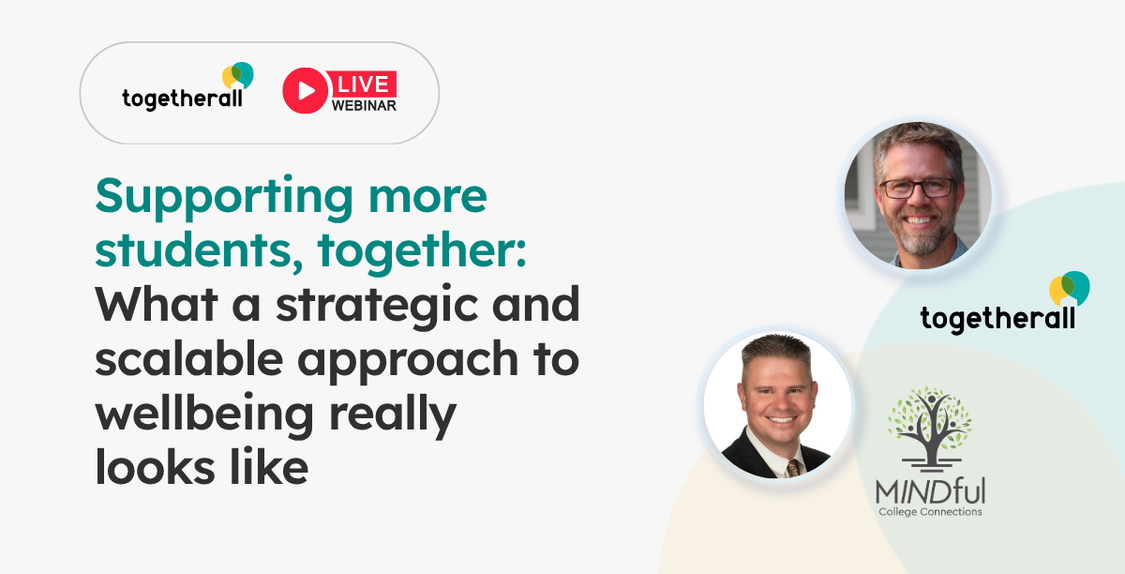
A conversation with Curtis Wiseley, Psy.D., Executive Director of MINDful College Connections, and Ben Locke, Ph.D., Chief Clinical Officer at Togetherall. How to supplement services with 24/7 clinically moderated student mental health support and offer counseling center capacity solutions.

Ask most counseling center directors how they’d build a mental health strategy from scratch, and they’ll tell you they’ve never had the chance. They inherited a team, a caseload, and a waiting list, and they’ve been managing demand ever since.
Curtis Wiseley got a blank slate.
When MINDful College Connections (MCC) was founded, Curtis was brought in as its first Executive Director with a mandate to work together with the partnering institutions to build something genuinely new: a shared mental health infrastructure serving multiple institutions, designed collaboratively, negotiated collectively, and built to scale. No inherited model to work around. No existing contracts to honor. Just a question: what do these students actually need?
Four years in, the answer is taking shape, and the results are worth paying attention to.
Where the idea came from
The MCC consortium began with three Indiana institutions: DePauw University, Rose-Hulman Institute of Technology, and Saint Mary-of-the-Woods College. All three faced the same problem that most counseling directors know well. Growing student need, and limited resources to meet it.
Rather than each institution trying to solve that problem alone, they partnered, applied for a grant from Lilly Endowment, and used the funding to build a shared consortium model designed to expand services more efficiently and at substantially lower cost.
“What also makes this consortium unique is that we’re not a for-profit company. We’re just fellow institutions partnering together to help each other, and to serve our students’ mental health and wellbeing needs.” — Curtis Wiseley
Butler University has since joined as a fourth member, bringing the total student population served to around 10,000. The consortium is actively looking to grow and does accept institutions from outside Indiana. Those interested in joining can contact MCC through their website, https://www.mindfulcollegeconnections.org/.
Building the model collaboratively
Every service in the consortium’s portfolio was chosen collaboratively by the counseling center directors themselves. Not handed down. Not selected by a procurement team. Decided together, starting with a simple question.
“It just started with open conversations about what’s on your wish list. Given what you know about your students, what kinds of services and resources do you believe would be most beneficial that you don’t already have?” — Curtis Wiseley
The result is a comprehensive stepped care model spanning social connection and belonging tools, peer mental health support, psychoeducation, screenings, on-campus counselors and mental health educators, telehealth counseling and psychiatric services, crisis support, continuing education for staff, and electronic medical records software.
Togetherall sits within that model as the anonymous peer community with 24/7 clinical moderation at scale, serving students who are struggling and perhaps have not taken that next step on their mental health journey.
Critically, MCC’s position is that none of this replaces existing counseling center support options. It supplements it.
“The intention here is that everything the counseling center is providing remains in place. We’re just trying to dovetail with that and insert some additional services and resources, up and down our continuum.” — Curtis Wiseley
The economics of collective bargaining
Because MCC negotiates on behalf of multiple institutions simultaneously, it can secure volume discounts no individual campus could access alone. On average, that means around 40% in cost savings per institution on the full package of services compared to what each school would pay negotiating separately. As Curtis put it: “Not 3% or 5%, but 40% is pretty substantial.”
There is also an administrative efficiency that is easy to underestimate. The consortium holds a single umbrella contract with each provider. Adding a new institution is a simple amendment, with no full renegotiation required.
And institutions do not have to take everything. MCC has moved to an à la carte approach, allowing member schools to opt into the services most relevant to their campus and existing provision.
The outcomes behind the model
Since implementing MCC’s services, member institutions have seen a 12% reduction in students withdrawing for mental health reasons, and a 6% increase in four-year graduation rates. Ben Locke framed the retention figure directly: those outcomes go to the bottom line of the institution.
Beyond retention, the consortium has expanded the reach of mental health support to students who are not counseling center clients at all, which is precisely the population a comprehensive wellbeing strategy should be designed to reach.
“Without population-level mental health services available, the default solution for any kind of mental health or wellbeing need becomes: schedule an appointment at the counselling center. But that unnecessarily drives up demand beyond what the counseling center can meet, when some of those students could have been better served with immediate self-help and peer support resources.” — Curtis Wiseley
What happens when demand shifts
Because counseling and psychiatric sessions are purchased as a shared pool across all member institutions, demand fluctuations at any one campus don’t result in waste or shortfall. If utilisation drops at one institution and spikes at another, sessions can be reallocated. Consortium-wide, no sessions go unused, and the partnering institutions collaborate to support each other when unexpected spikes in demand occur.
It is a structural flexibility that individual institutions managing their own contracts cannot easily replicate.
The question worth taking back to your institution
Curtis Wiseley spent 17 years as a counseling center director before stepping into this role. He knows the experience of watching need grow and resources stay flat. What MCC represents is a different response to that problem, not working harder within the same constraints, but changing the structure itself.
The consortium model won’t be the right fit for every institution. But the questions it raises apply everywhere. Which students are you not yet reaching? What would it look like to design your strategy for the students who will never come through your door? And is there a way to do that which is both more effective and more affordable than what you’re doing today?
If you’d like to explore Togetherall’s clinically moderated student mental health platform for universities, you can watch the webinar on demand or get in touch with our team.
togetherall.com