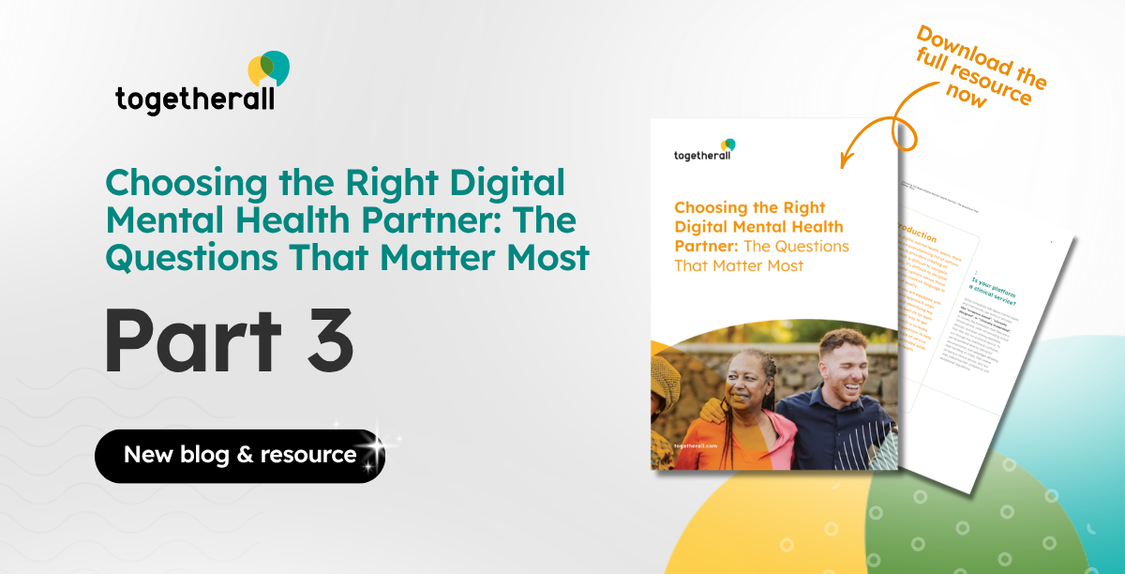
Choosing the Right Digital Mental Health Partner: The Questions That Matter Most (3/7)
This is the third in a seven-part series from Togetherall's Chief Clinical Officer, Dr. Ben Locke – practical questions to ask when evaluating digital mental health providers and cutting through the noise.
Within the digital mental health space, there seems to be an overwhelming list of options when it comes to providers creating an environment that is difficult to navigate. More specifically, it’s difficult to decipher higher quality, safer options versus those options that may use creative language to create the illusion of quality.
It is imperative that you are equipped with the right knowledge and approach when vetting these options and identifying the partners that provide the best fit for both strategy and quality. A great way to get started or reset your approach is to make sure you’re asking the right questions to help you better understand what type of service and support is actually being provided when you look to expand your mental health support network.
The third blog in this series is about clinical moderation. If you missed any of the earlier pieces, they are available here. Additional ones are coming soon.
3. Can you provide the details of your clinical-moderation staff and coverage?
True clinical moderation is expensive and requires complex staff scheduling and coordination to achieve 24/7 coverage sufficient to both moderate the content AND care for members at risk.
Some providers manage risk through limited moderation windows – for example, only reviewing content during set hours (such as 9–5), often because posts are pre-moderated before being published to the community. While this approach may control what appears on the platform, it can also create gaps in real-time support particularly outside of those hours, when individuals may still be at risk but unable to receive timely intervention.
A question to consider as a starting point: When you refer to 24/7 moderation or support, does that mean live review by licensed clinicians at all times, or queued review within defined operating windows?
Keep in mind that true clinical moderation means that all decisions about content are made by a licensed/registered mental health professional. Most peer-community platforms rely on volunteers (or other similar names like “buddies”) to evaluate content. However, clinical moderation requires that a licensed clinician evaluate flagged content. A lightly trained volunteer is not the same. Similarly, if AI or Machine Learning is making any decisions about content, that should be disclosed with details. The technical-sounding phrase “human-in-the-loop moderation” is sometimes used to confuse and distract from volunteer vs. professional moderation. The real question here is “which humans” are in the loop and what are they doing? Ask for details about which humans are doing moderation.
This is the third in a seven-part series on choosing the right digital mental health partner. If you want the complete set of questions in one place – without waiting for each post – the full guide is available to download now.
About Togetherall
Established in 2007, Togetherall is available to more than 20 million individuals worldwide. Togetherall is the leading clinically managed, peer-to-peer, online support community where members can share what’s on their minds, anonymously, safely, and in-the-moment, 24/7/365. Members can connect through shared lived experiences with a global network of peers, backed by the safeguarding of more than 50 licensed clinicians overseeing the community around-the-clock. These clinicians empower individuals in peer support and foster and maintain a safe, vibrant environment.
If you are interested in offering safe and scalable ways to support your people’s mental health, contact us to book a demo and learn more about Togetherall’s online community.