

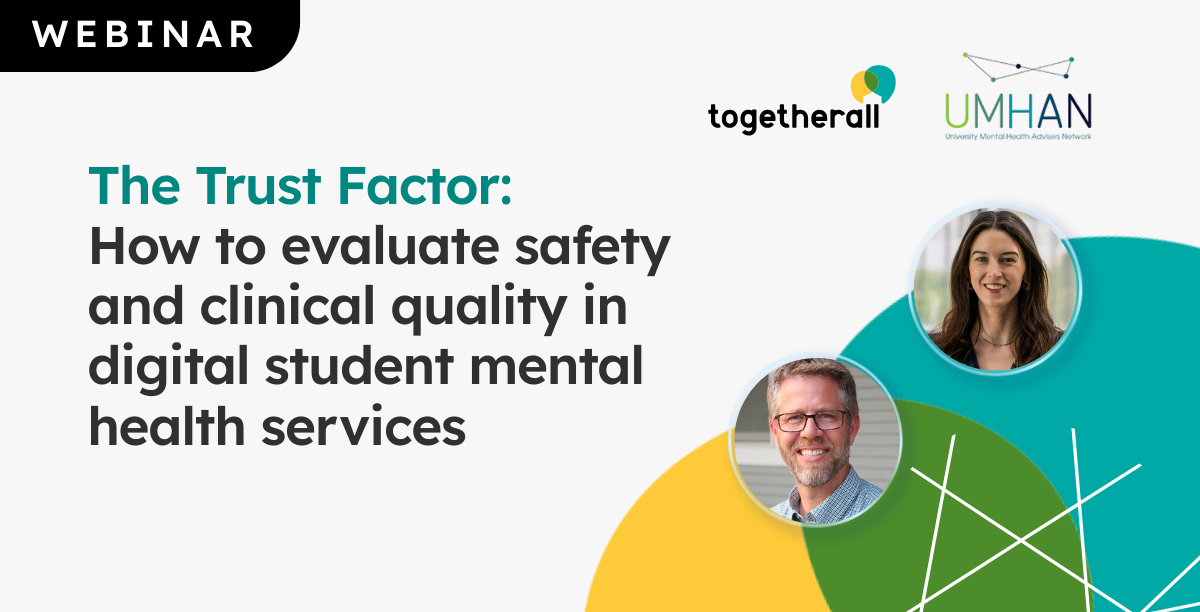
Blog & Webinar: How to Evaluate Safety and Clinical Quality in Digital Student Mental Health Services
March 18 2026

Digital mental health services have grown rapidly – and so has the pressure on universities and healthcare organisations to make confident, responsible decisions about which platforms to trust. In our recent webinar, The Trust Factor, Dr. Ben Locke and Kristy Robinson explored exactly that: what good looks like when it comes to clinical governance, safety, and the real-world challenges of choosing the right digital mental health partner.
This post brings together the key insights from that conversation – for any institution navigating a crowded and, at times, confusing market.
The context: why digital mental health services matter more than ever
Both the UK and US higher education sectors are facing the same fundamental challenge: demand for mental health support has grown – not just in volume, but in complexity. More students are seeking help, and their needs are more varied and acute than ever.
But institutions can’t simply hire their way out of this. Resource constraints are real. And critically, traditional one-to-one counselling isn’t always the right fit for every student, or what every student actually wants.
“We’ve grown a lot in our understanding of what students want and need. One-to-one psychotherapy isn’t always what students want, or what they need — so what else is out there?” — Kristy Robinson
Digital mental health services have stepped in to expand what institutions can offer – from peer support communities and wellbeing apps to 24/7 helplines and online resources. The shift isn’t a replacement for clinical services. It’s a broadening of the portfolio.
As Ben put it, the most effective approach is a ‘both/and’ mindset: continuing to advocate for face-to-face clinical resource while also building a range of additional access points for students who might not otherwise seek support at all.
The Wild West problem: too many options, not enough scrutiny
With more digital platforms entering the market every year, institutions are being pitched to constantly. The challenge is knowing how to evaluate what’s actually being offered — and what claims to scrutinise.
“There’s a new app or platform coming out every day — and if you’re in a leadership position at a university, you probably get the emails. Sign up here. We want to help your students.” — Kristy Robinson
Ben was direct about this: not all ‘clinical moderation’ is equal. Many platforms offer what’s called passive signposting – if a certain word is detected, an automated message is triggered directing users to a resource. That’s very differentfrom having licensed clinicians reviewing content in real time, actively managing risk, and maintaining a structured escalation process.
His advice to anyone evaluating a digital mental health platform: ask for the details. Don’t accept vague claims at face value.
- Ask: What exactly do you mean by clinical moderation?
- Ask: Who are the clinicians? What are their qualifications?
- Ask: Can you share your escalation policies and procedures?
- Ask: How do you handle duty of care when a member is identified as at risk?
If a vendor can’t answer these questions immediately and clearly, that tells you something important.
Clinical governance: what it actually means
The phrase ‘clinical governance’ is more familiar in the UK than in the US, but the principles are universal. Kristy broke it down clearly: clinical governance is a framework for ensuring that the support provided to students is safe, effective, and accountable.
That means three things:
- Safety – are students protected when they engage with this service?
- Effectiveness – can you actually demonstrate outcomes, not just satisfaction scores?
- Accountability – is there an ongoing process of reporting, review, and improvement?
It’s also worth noting that clinical governance isn’t just about what’s written in a policy document. It’s about culture – whether teams are genuinely and continuously reflecting, reviewing, and improving, rather than simply ticking boxes.
“It’s a culture of accountability. It’s equally about what’s documented and what’s actually happening on the ground.” — Kristy Robinson
For institutions working towards the University Mental Health Charter, robust clinical governance is one of the most significant parts of the assessment. This includes how digital partners are evaluated – not just in-house counselling services.
As Kristy pointed out, too many institutions still treat a digital platform as a set-and-forget solution: sign the contract, put it on the website, and assume it runs itself. That’s the opposite of what clinical governance requires. A digital partner should be treated as an extension of your services – and evaluated with the same rigour.
What rigorous clinical governance looks like in practice: Togetherall as an example
Togetherall is a clinically moderated peer-to-peer support platform. Every interaction in the community is reviewed by a qualified, licensed mental health professional on duty, around the clock, every day of the year.
When a member’s posts or messages suggest they may be at risk or in significant distress, a structured escalation process is triggered:
- Content is flagged and escalated through a three-tier clinical team.
- A Level 3 clinician acts as an intensive case manager, working off-platform when needed.
- The case remains open until a confirmed handoff is made to the most appropriate next resource – whether that’s the university wellbeing team or emergency services.
- Every case goes through a closed case review when it’s concluded.
This isn’t passive. It’s an active duty of care – one that’s now regulated by the MHRA in the UK as a software as a medical device. Togetherall is currently the only peer support platform in the UK to hold this status.
Each university partner also works with Togetherall to develop a customised risk management agreement – so that when escalation is needed, the response follows the institution’s own protocols.
Making the most of digital mental health services: getting utilisation right
One question raised by attendees was around student uptake. What do you do when a platform isn’t being used as much as expected?
Both Ben and Kristy were aligned on this: the answer is rarely that the service is wrong. It’s often about how it’s being promoted – and by whom.
“If it’s just staff members mentioning it in emails, it falls flat. Having students promote services to other students goes a long way.” — Kristy Robinson
Student ambassadors, paid student employees, and peer-led promotion are consistently more effective than top-down institutional messaging. Students are critical consumers of their time and trust — and they respond to peer voices.
Ben added that a ‘no wrong door’ approach is the right mental model. Digital services aren’t trying to replace counselling – they’re providing additional access points for students who won’t seek help through traditional routes. The goal is reach and in-the-moment support, not replication of clinical services.
Data from Togetherall shows that around 80–90% of students using the platform are not accessing any other mental health services. That’s the population digital platforms are uniquely positioned to reach.
Key takeaways for institutions evaluating digital mental health partners
Whether you’re in the process of choosing a new platform or reviewing an existing partnership, here’s what the conversation surfaced:
- Treat digital platforms as extensions of your clinical services – with the same governance expectations.
- Ask detailed questions about clinical moderation. Understand what ‘moderation’ actually means in practice.
- Understand the escalation process – how are at-risk members identified, supported, and handed off?
- Look for regulation and independent verification. In the UK, MHRA alignment for software as a medical device is a meaningful marker of clinical rigour.
- Co-produce with students. Involve them in procurement decisions and in promoting any platform you do deploy.
- Think strategically. Digital services work best as part of a coherent, long-term mental health support ecosystem – not as standalone add-ons.
- Don’t set and forget. Ongoing monitoring, reporting, and review are essential.
The right question isn’t ‘do we need digital mental health services?’ – it’s ‘how do we choose partners we can genuinely trust?’ That trust has to be earned through transparency, rigour, and a shared commitment to student wellbeing.
If you’d like to learn more about how Togetherall supports institutions with safe, clinically governed peer support, you can watch the webinar on-demand or get in touch with our team.
togetherall.com


